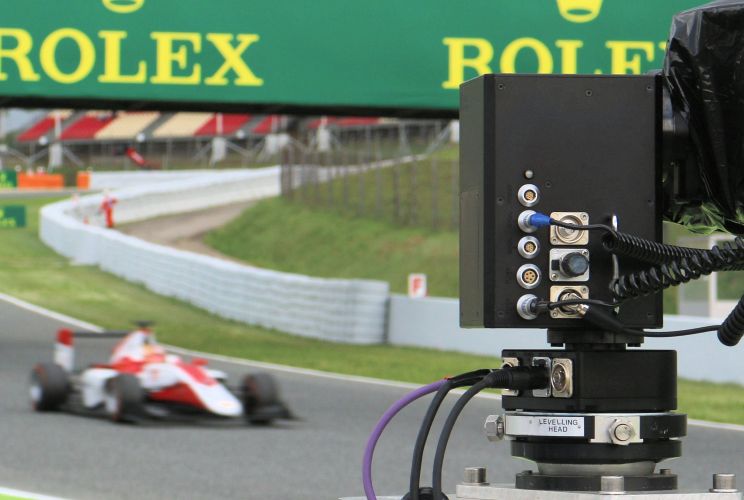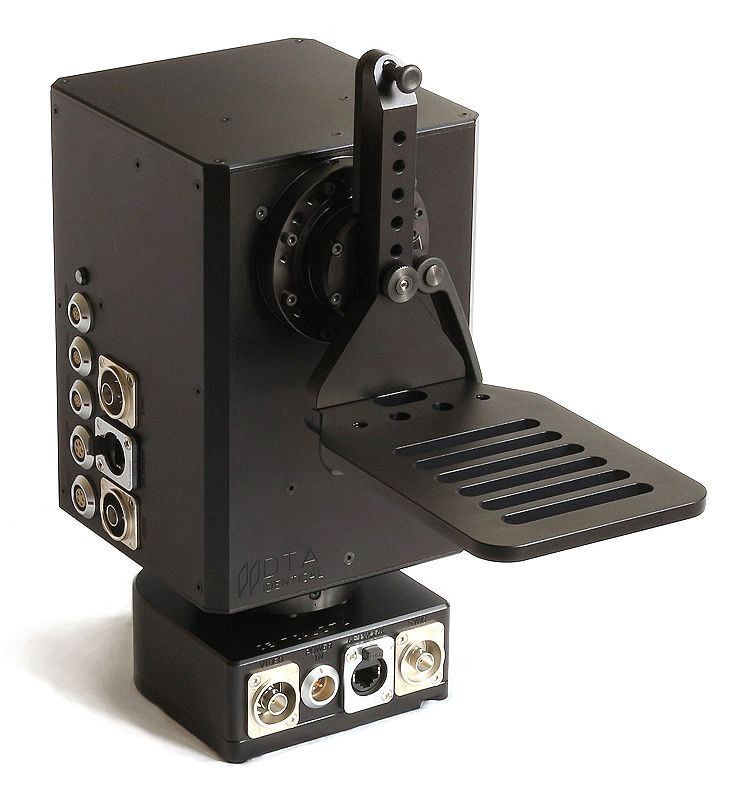
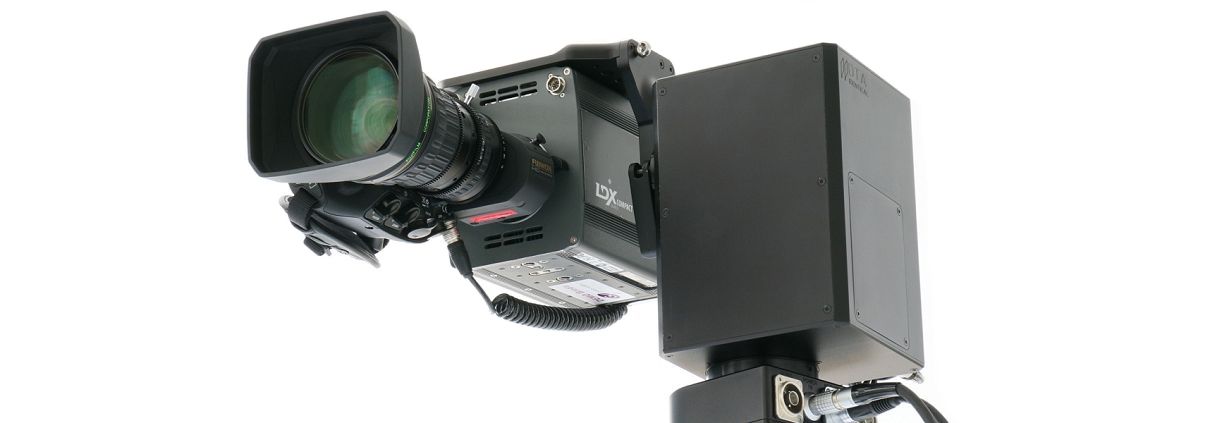
For the more demanding applications where power and agility are required, the DTA remote head can easily keep up with the fastest of motorsports.
The intuitive control customisations allow the operator to quickly harness the head’s reflexes, letting them capture close-up fast paced action with ease.
Fibre optic slip-rings
Optional fibre optic slip-rings can be installed, for feed through of 4K resolution video.
Standard ethernet network connectivity
Communication with the head is via ethernet, allowing it to connect to standard networks. The IP address can easily be set with the MCC Controller or our smart-phone app.
Pixel perfect frame accuracy
The position resolution is suitable for motion control, e.g. an object viewed from from 50m will be accurate to 1.0mm.
Smooth Motion
The exceptionally high resolution of the absolute encoders, coupled with the near zero backlash of the gearboxes is primarily what gives the head its smooth motion (even at high magnification), but you also need a robust motor feedback algorithm to take full advantage of these features. The powerful motors are finely controlled to manipulate the camera extremely smoothly, throughout the entire speed range, yet respond instantly to sudden demands for acceleration without jumping or shaking. The user can adjust the speed, acceleration and deceleration to suit the shot so the controls are easy to operate.
No Position Zeroing Required
All our heads are fitted with absolute encoders and are factory calibrated, so zero degrees pan and tilt will always point in exactly the same direction, every head, every time.
Interfaces with all popular digital lenses and lens control systems
Simply plug in your chosen lens cable, select the lens (Canon/Fujinon/C-Motion/RED etc) from the drop down list of the user interface, and you’re ready to go. If a particular lens isn’t available and you need it we are happy to add the protocol.
Mount any camera
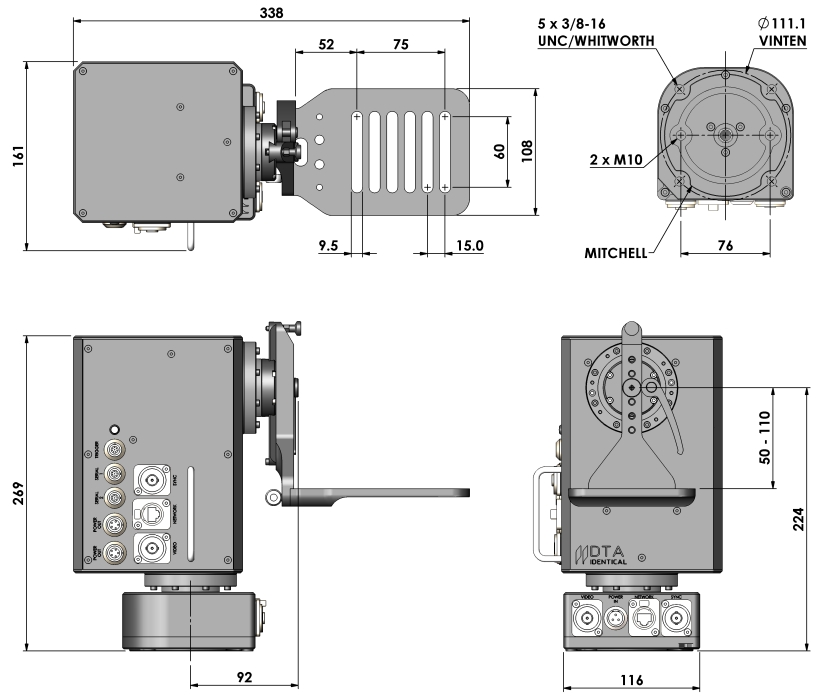
The camera arm has many slots to accommodate a variety of camera configurations. For extra stability there is a hole at the base of the arm which allows the supplied velcro strap to wrap fully around the camera and arm holding them firmly together.
Android phone app
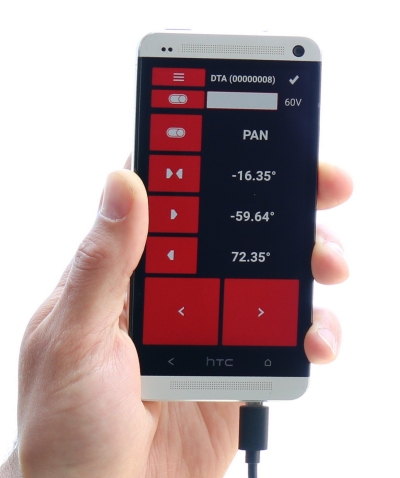
Your smart-phone can be plugged directly into the head using our USB to serial cable. Having installed the Identical Catalyst app you will be able to: check the head is communicating with the controller, set the lens make, move all the head axes (pan/tilt/zoom/focus etc), and set the position soft-limits. The soft-limits can be set using the MCC controller, but using the Catalyst app you can set the soft-limits while you’re next to the head, avoiding the possibility of hitting a nearby object. The absolute position measurement means that the head can be power-cycled and still maintain the same position limits, the same applies for position presets (shotbox).
Acceleration expectations
A mid-sized camera of around 7kg will accelerate at 720°/s², this is the acceleration limit of the head; lighter cameras will also achieve this value. A camera with more inertia will take longer to get to the top speed of 240°/s. A large camera of around 15kg with a long heavy lens, will accelerate at around 70% of the maximum. The head is easily capable of carrying and moving these loads, only with less of the agility that is achievable with the medium sized cameras.
Intelligent Communication
Safety critical design methods, similar to that used in aircraft software, have been employed in the design of the system. Strong error checking is performed on communication to prevent use of corrupt data and fail-safe mechanisms control the head movement. The communication is tolerant to data loss, filling in the gaps to allow smooth movement even when comms are unreliable.
Tethering
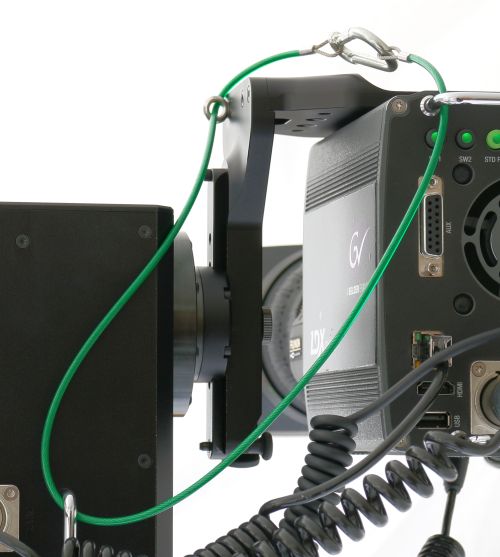
The camera arm has two loop-though points allowing it to be tethered to the sturdy handle on the head casing.
Fits standard mounts
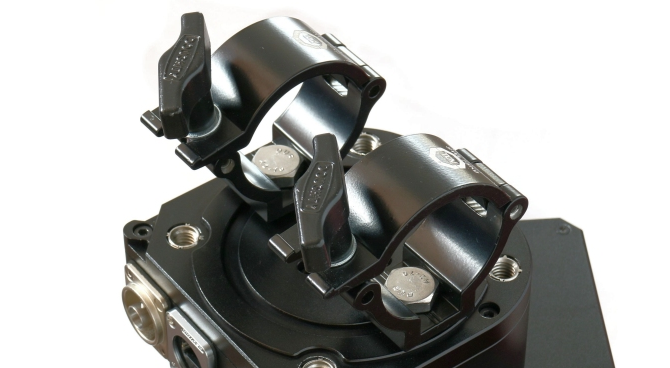
There’s no need for any bolt-on adaptors for the head base, it’s an all-in-one design. There’s a standard 3/8th Whitworth female thread in the center, a further four arranged in the Vinten four-hole layout, two M10 female threads to which the supplied scaffold brackets fit, and features for locating on a Mitchell mount, including a key to lock rotation.
Detachable Camera Arm
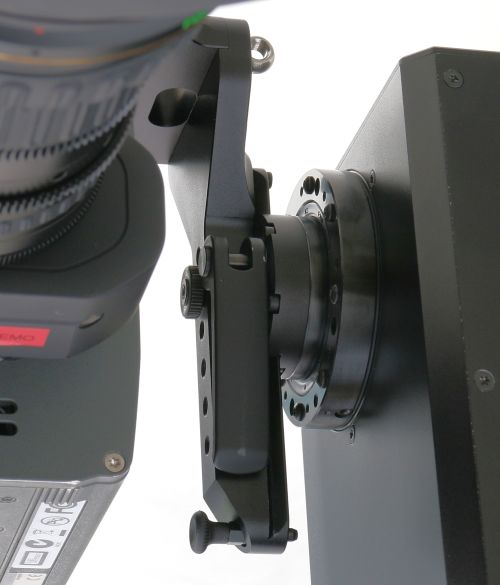
The fiddly process of bolting the camera to the arm is much easier with the arm detached. The arm and camera slide back into the dovetail groove on the head, and a quick release lever locks them in place. The height of the arm can easily be adjusted so the axis of tilt passes through the centre of the lens optics.
3G-SDI slip-rings
Slip-rings allow un-limited pan rotation and can pass through 3G-SDI video, 1Gbit Ethernet, video sync and power.
Supports Virtual Graphics
Highly accurate head position data can be streamed from the Motion Control Centre. The position data can be output in a range of formats e.g. Free-D. The accuracy and timing of the position data make it suitable for third party virtual graphics software.
Withstands Harsh Environments
The head can withstand extremes of weather, it has been thoroughly tested and has an operating temperature range of -20°C (-4°F) to +60°C (140°F). The head casing is fully sealed (IP65), preventing the ingress of dust, sand and rain. Internal vibration absorbers protect the electronics from mechanical shock, and the tough case can withstand rough handling. A handle facilitates carrying the head.
Wide supply voltage range
The head supply voltage operating range is 16V to 60V. The top-speed and acceleration of the head are proportional to the supply voltage, if the supply voltage drops, the top speed and acceleration will drop. The head monitors the supply voltage, limiting speed and acceleration demands to prevent the head from tripping. The controller will also automatically scale the controls so the operator inputs are always within the achievable range of the head. Long power cable runs will cause voltage drop which will limit the top speed, so it’s best to place the PSU close to the head. Running from batteries will mean that the top speed and acceleration decrease as the battery discharges.
Powering the Head
The controller can supply power directly to the head at 60V, so if the controller is near the head you can use the controller for power. If the controller is more than 20m from the head it is best to use the PSU and place it close to the head, so voltage is not lost over a long cable run.
Rugged future-proofed cables
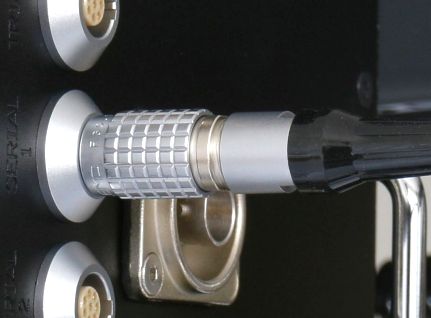
All our cables are fitted with waterproof locking Lemo connectors, to ensure a strong and reliable connection. We have standardised all our connections so everything will fit and work now and way into the future, across all our product lines. We have made sure that it’s impossible to damage anything by plugging a cable into the wrong socket. All our connectors are keyed and pin numbers have been standardised. Pins for power and pins for comms are never mixed, so even if you manage to force a plug in, it wouldn’t cause any further damage.
Bolt-on Modules
The access panel on the side of the head can be removed and a bolt-on module attached. These modules can provide additional voltages, wireless communications, or DC motor control. If you have a specific requirement we can develop new modules to suit your needs.
Peli Cases
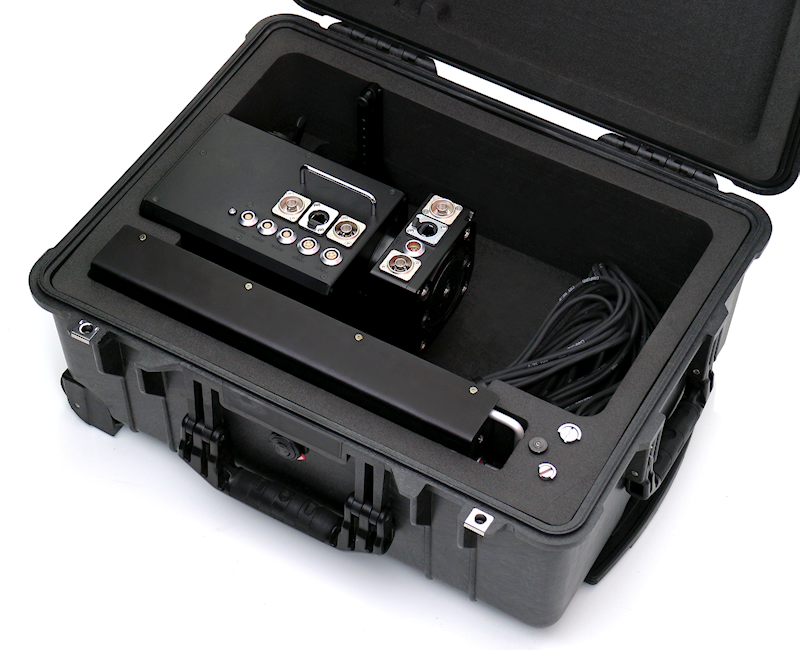
Our products can optionally be supplied in tough Peli cases fitted with custom cut foam to securely and tidily store and transport your equipment.